> ## Documentation Index
> Fetch the complete documentation index at: https://benchgen.com/docs/llms.txt
> Use this file to discover all available pages before exploring further.
# Deploy with DT Edge Platform
> Install and manage the BenchGen Helm release from the DT Edge Platform UI.
 DT Edge Platform is the edge-computing offering of [DT Cloud](https://dtcloudnow.com/en/) - Türkiye's hyper-scalable, self-service cloud computing platform, built around full data compliance and digital sovereignty. It manages Kubernetes edge instances, a private image registry, a Helm marketplace, virtual machines, and monitoring from a single console.
If your cluster is connected to the **DT Edge Platform**, you can install and upgrade BenchGen entirely from its UI instead of running Helm yourself. DT Edge Platform stores the chart versions in its marketplace, applies your values, and then tracks the release - pods, logs, metrics, and storage - per edge instance.
You still need everything from the [Helm prerequisites](/docs/deploy/helm#prerequisites) in place on the target cluster: ingress controller, cert-manager, the `dockerhub-creds` pull secret, and DNS for every hostname in your values.
***
## Air-gapped environments
DT Edge Platform is built for air-gapped installs: every image is served from the **platform registry**, not from the public internet. The container runtime on each edge node mirrors `docker.io` through the registry's pull-through proxy (the `dockerhub-proxy` project), so the chart's canonical image names keep working with zero values changes - pulls never leave the platform.
For a fully offline site, pre-load all chart images into the platform registry before installing. Alternatively, mirror the images under your own registry namespace and override the repositories in values - see the [Helm values reference](/docs/deploy/helm-values) (`image.*` for the core components; the agentspace service images live inside each service's `containers` list in the chart defaults, so overriding one means copying that whole list).
Either way, the pull secret (`dockerhub-creds` by default) must hold credentials for the registry the images are actually pulled from.
***
## 1. Find the package in the Marketplace
Open **Marketplace** in the left sidebar and locate the `benchgen` package. Every published chart version is available under one card - the version is selected at install time.
DT Edge Platform is the edge-computing offering of [DT Cloud](https://dtcloudnow.com/en/) - Türkiye's hyper-scalable, self-service cloud computing platform, built around full data compliance and digital sovereignty. It manages Kubernetes edge instances, a private image registry, a Helm marketplace, virtual machines, and monitoring from a single console.
If your cluster is connected to the **DT Edge Platform**, you can install and upgrade BenchGen entirely from its UI instead of running Helm yourself. DT Edge Platform stores the chart versions in its marketplace, applies your values, and then tracks the release - pods, logs, metrics, and storage - per edge instance.
You still need everything from the [Helm prerequisites](/docs/deploy/helm#prerequisites) in place on the target cluster: ingress controller, cert-manager, the `dockerhub-creds` pull secret, and DNS for every hostname in your values.
***
## Air-gapped environments
DT Edge Platform is built for air-gapped installs: every image is served from the **platform registry**, not from the public internet. The container runtime on each edge node mirrors `docker.io` through the registry's pull-through proxy (the `dockerhub-proxy` project), so the chart's canonical image names keep working with zero values changes - pulls never leave the platform.
For a fully offline site, pre-load all chart images into the platform registry before installing. Alternatively, mirror the images under your own registry namespace and override the repositories in values - see the [Helm values reference](/docs/deploy/helm-values) (`image.*` for the core components; the agentspace service images live inside each service's `containers` list in the chart defaults, so overriding one means copying that whole list).
Either way, the pull secret (`dockerhub-creds` by default) must hold credentials for the registry the images are actually pulled from.
***
## 1. Find the package in the Marketplace
Open **Marketplace** in the left sidebar and locate the `benchgen` package. Every published chart version is available under one card - the version is selected at install time.
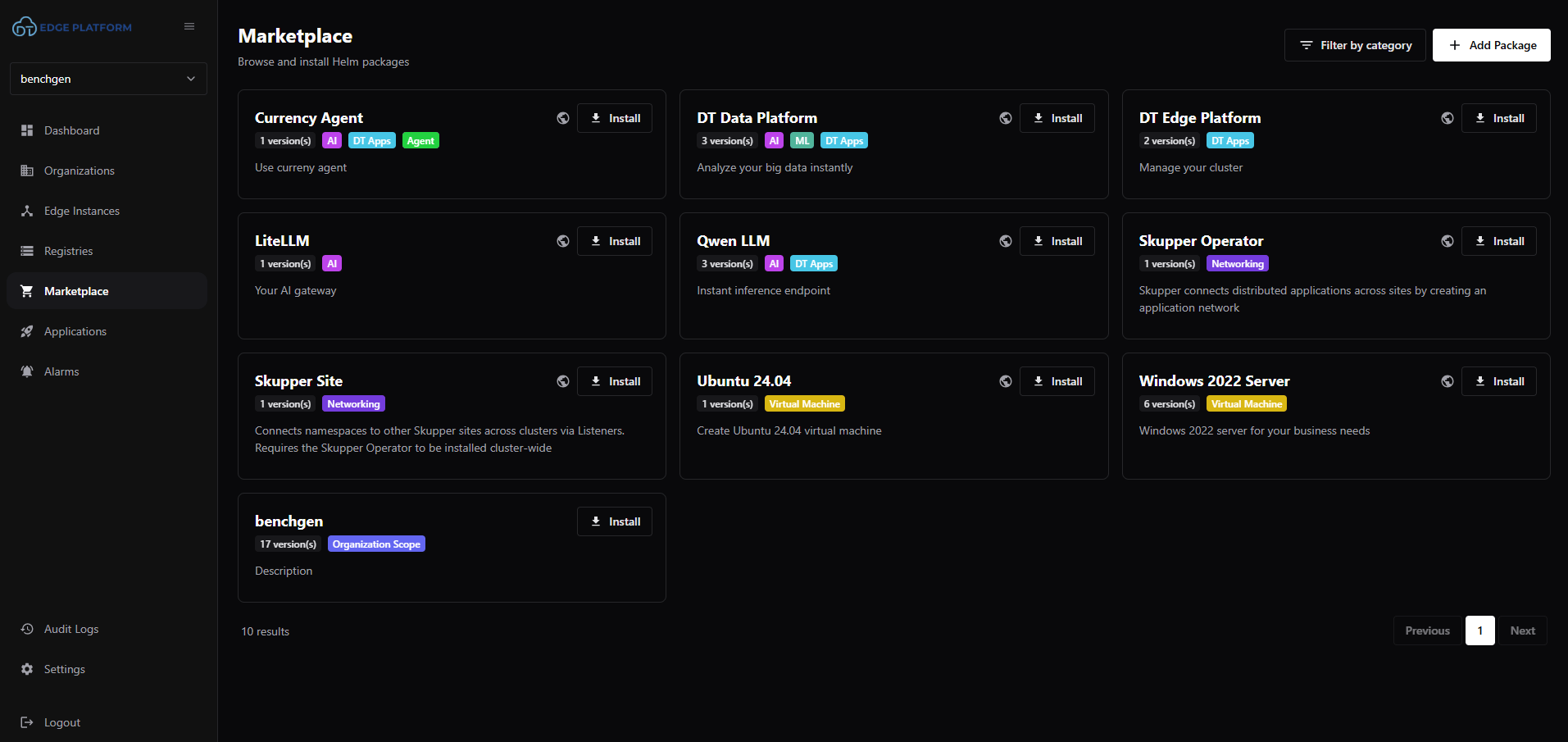 If the package is missing, add it with **Add Package** (upload the chart `.tgz` or point at the chart repository). Packages added with organization scope are visible to your whole organization.
***
## 2. Install
Click **Install** on the `benchgen` card and fill in the dialog:
If the package is missing, add it with **Add Package** (upload the chart `.tgz` or point at the chart repository). Packages added with organization scope are visible to your whole organization.
***
## 2. Install
Click **Install** on the `benchgen` card and fill in the dialog:
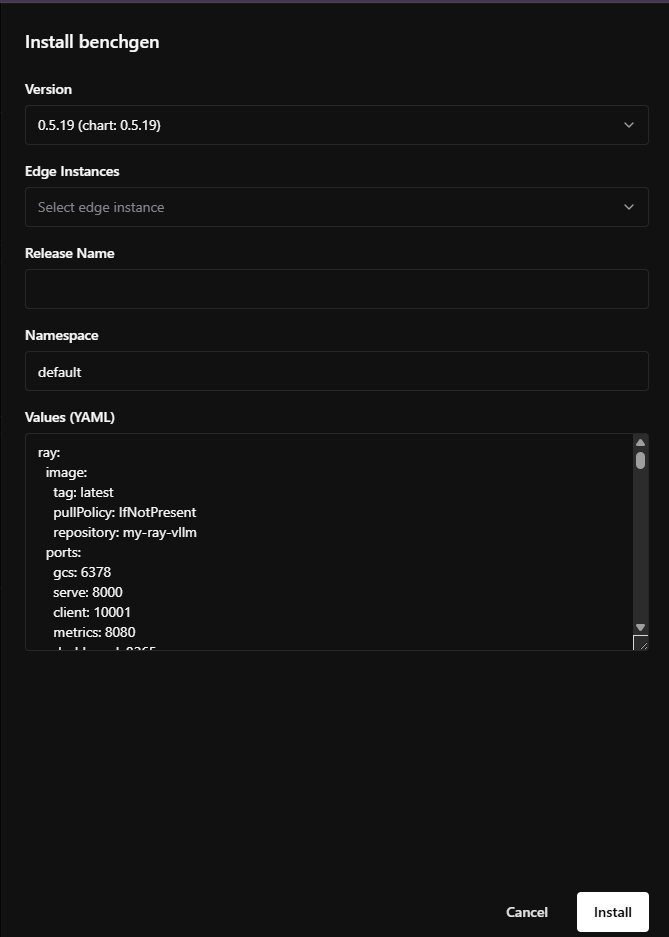 | Field | What to enter |
| ------------------ | ------------------------------------------------------------------------------------------------------------------------------- |
| **Version** | The chart version to deploy - pick the latest unless you are pinning intentionally |
| **Edge Instances** | The connected cluster to deploy to |
| **Release Name** | Helm release name, e.g. `benchgen` |
| **Namespace** | Target namespace, e.g. `benchgen` (created if missing) |
| **Values (YAML)** | Your full deployment values - paste the completed file from the [values template](/docs/deploy/helm-values#complete-values-template) |
The values editor is pre-filled with the chart defaults. Replace its content with your own values file - the same one you would pass to `helm -f`, with all `CHANGE-ME` placeholders and hostnames filled in.
Click **Install**. DT Edge Platform runs the Helm install, including the [bootstrap hooks](/docs/deploy/helm#install) (migrations and the two admin-init jobs).
***
## 3. Track the release in Applications
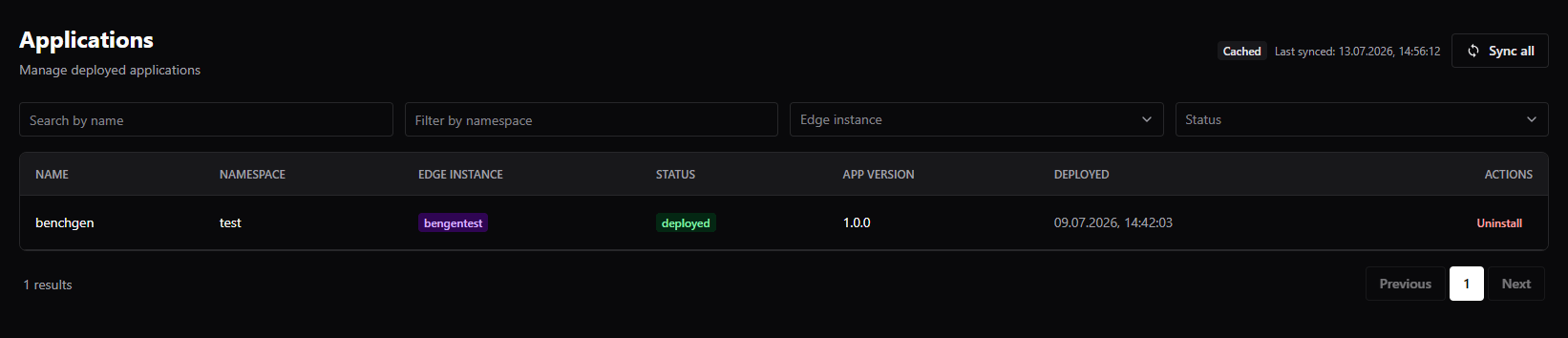
The release appears under **Applications** with its namespace, edge instance, and Helm status:
| Field | What to enter |
| ------------------ | ------------------------------------------------------------------------------------------------------------------------------- |
| **Version** | The chart version to deploy - pick the latest unless you are pinning intentionally |
| **Edge Instances** | The connected cluster to deploy to |
| **Release Name** | Helm release name, e.g. `benchgen` |
| **Namespace** | Target namespace, e.g. `benchgen` (created if missing) |
| **Values (YAML)** | Your full deployment values - paste the completed file from the [values template](/docs/deploy/helm-values#complete-values-template) |
The values editor is pre-filled with the chart defaults. Replace its content with your own values file - the same one you would pass to `helm -f`, with all `CHANGE-ME` placeholders and hostnames filled in.
Click **Install**. DT Edge Platform runs the Helm install, including the [bootstrap hooks](/docs/deploy/helm#install) (migrations and the two admin-init jobs).
***
## 3. Track the release in Applications
The release appears under **Applications** with its namespace, edge instance, and Helm status:
 Open the application to see the release details - chart version, revision, deploy time - plus live **Metrics** (CPU/memory per pod), **Logs**, **Workloads**, **Pods**, **Storage**, and **Network** tabs:
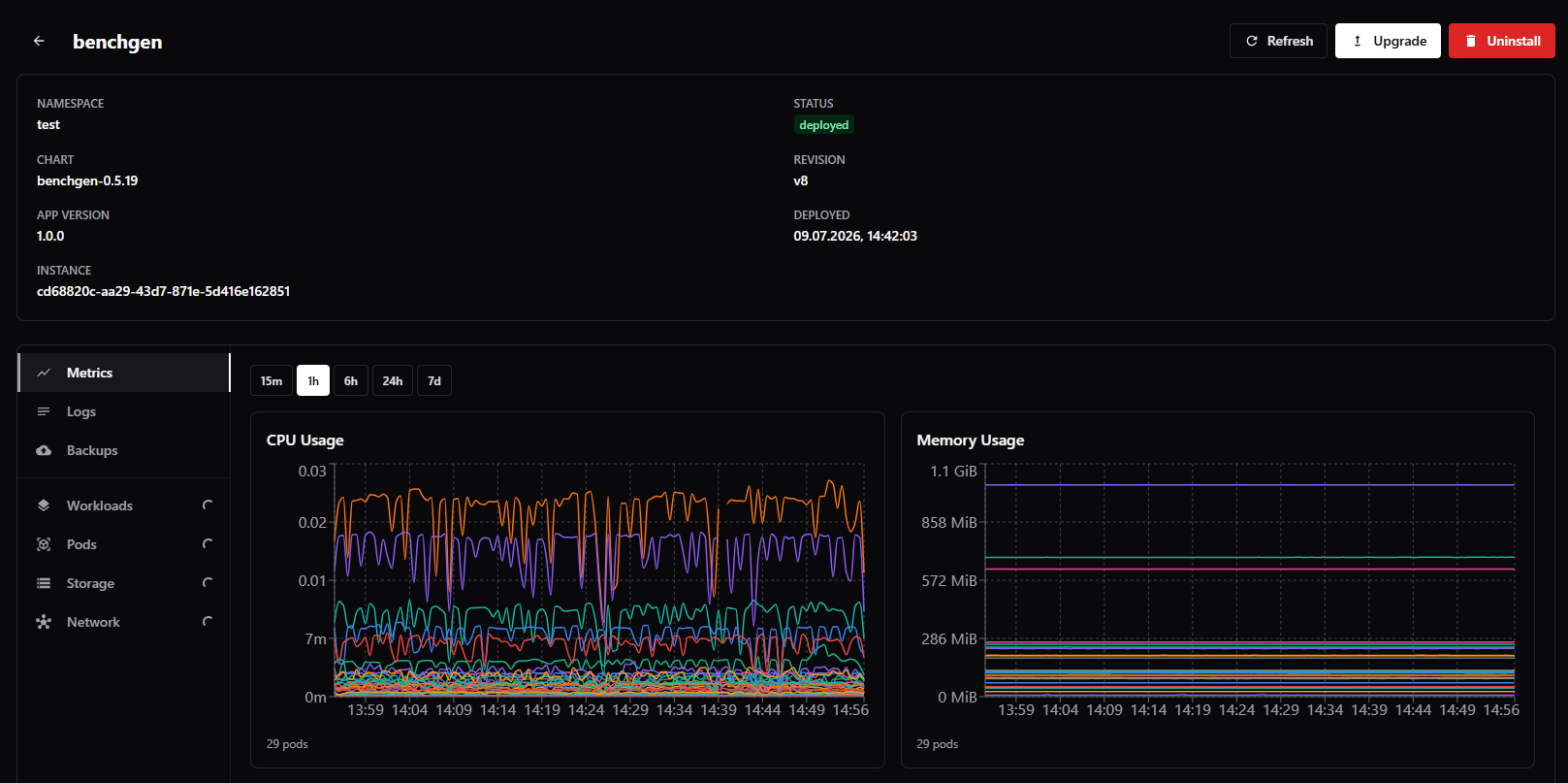 A healthy install shows status `deployed` and all pods Running (the hook jobs show as Completed).
***
## 4. Upgrade
Open the application and click **Upgrade**:
A healthy install shows status `deployed` and all pods Running (the hook jobs show as Completed).
***
## 4. Upgrade
Open the application and click **Upgrade**:
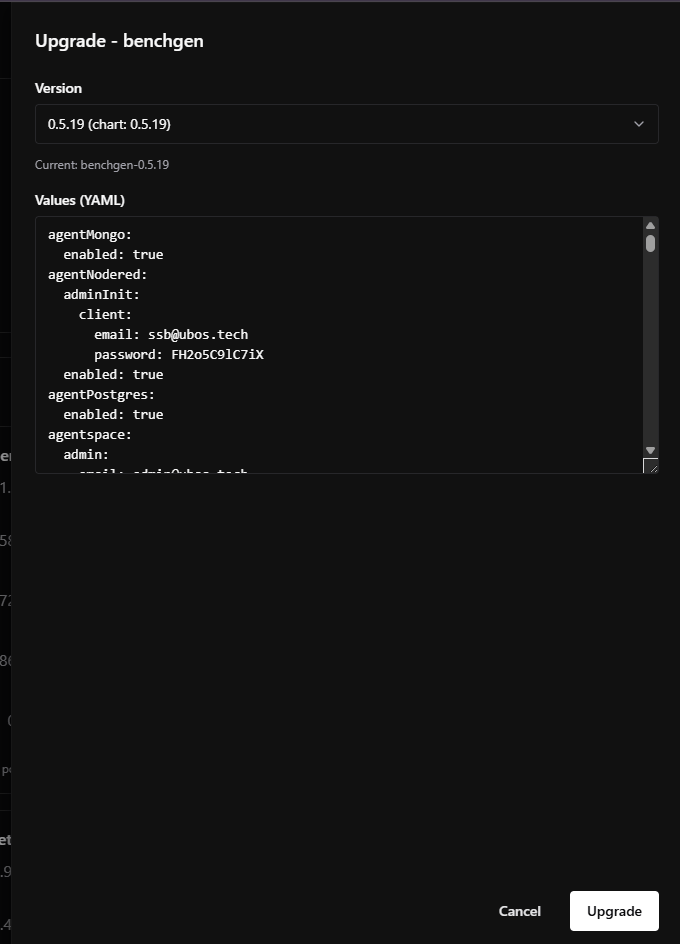 1. Select the chart version. You can keep the current version to apply a values-only change, or pick a newer one from the marketplace.
2. Edit the values YAML - the editor is pre-filled with the release's current values.
3. Confirm. Only pods whose rendered spec changed are restarted; data on PersistentVolumeClaims survives.
To remove the release, use **Uninstall** on the application page. Mind the [data warning](/docs/deploy/helm#upgrade): chart-managed PVCs are deleted with the release.
1. Select the chart version. You can keep the current version to apply a values-only change, or pick a newer one from the marketplace.
2. Edit the values YAML - the editor is pre-filled with the release's current values.
3. Confirm. Only pods whose rendered spec changed are restarted; data on PersistentVolumeClaims survives.
To remove the release, use **Uninstall** on the application page. Mind the [data warning](/docs/deploy/helm#upgrade): chart-managed PVCs are deleted with the release.