> ## Documentation Index
> Fetch the complete documentation index at: https://benchgen.com/docs/llms.txt
> Use this file to discover all available pages before exploring further.
# Add a Model
> Register a new model in Eval by uploading a model archive or importing one from HuggingFace.
Every evaluation and inference run starts from a model in your workspace. Adding one is a quick two-part flow: give the model a name, then choose where its weights come from. You can upload your own archive or import a model straight from HuggingFace.
***
## Two ways to add a model
| Source | Use when | What you provide |
| ------------ | ------------------------------------------------------------------------------- | ---------------------------------------------------------------- |
| **File** | You have your own weights, such as a fine-tuned checkpoint or a merged adapter. | A `.zip` archive containing `config.json` and the model weights. |
| **HF model** | You want a public model from the HuggingFace Hub. | A search term, then pick the model from the results. |
***
## Steps
### 1. Open the Models page and click Add Model
In the **Eval** tab, click **Models** in the left sidebar, then click **+ Add Model** in the top right of the **AI Models** page.
 ### 2. Enter the basic details
The **Add Model** panel slides in. Give the model a **name** (for example `myqwen3-0.6b-model`) and, optionally, a short **description**. You can edit the description later, so it's fine to leave it blank for now.
Click **Add Model** to continue. You'll choose where the weights come from on the next step.
### 2. Enter the basic details
The **Add Model** panel slides in. Give the model a **name** (for example `myqwen3-0.6b-model`) and, optionally, a short **description**. You can edit the description later, so it's fine to leave it blank for now.
Click **Add Model** to continue. You'll choose where the weights come from on the next step.
 Pick a name you'll recognize later in model lists and leaderboards. Avoid throwaway names like `test1`.
### 3. Choose where the model comes from
The model is created in a **Draft** state and opens to its model card. The **Add Model** card prompts you to choose a source. Pick one of the two tabs.
#### Option A — Upload a file
On the **File** tab, drag and drop a model archive onto the upload area, or click **Browse Files** to pick it. The archive should be a `.zip` containing `config.json` and the model weights.
Once the file is attached, click **Add model**.
Pick a name you'll recognize later in model lists and leaderboards. Avoid throwaway names like `test1`.
### 3. Choose where the model comes from
The model is created in a **Draft** state and opens to its model card. The **Add Model** card prompts you to choose a source. Pick one of the two tabs.
#### Option A — Upload a file
On the **File** tab, drag and drop a model archive onto the upload area, or click **Browse Files** to pick it. The archive should be a `.zip` containing `config.json` and the model weights.
Once the file is attached, click **Add model**.
 #### Option B — Import from HuggingFace
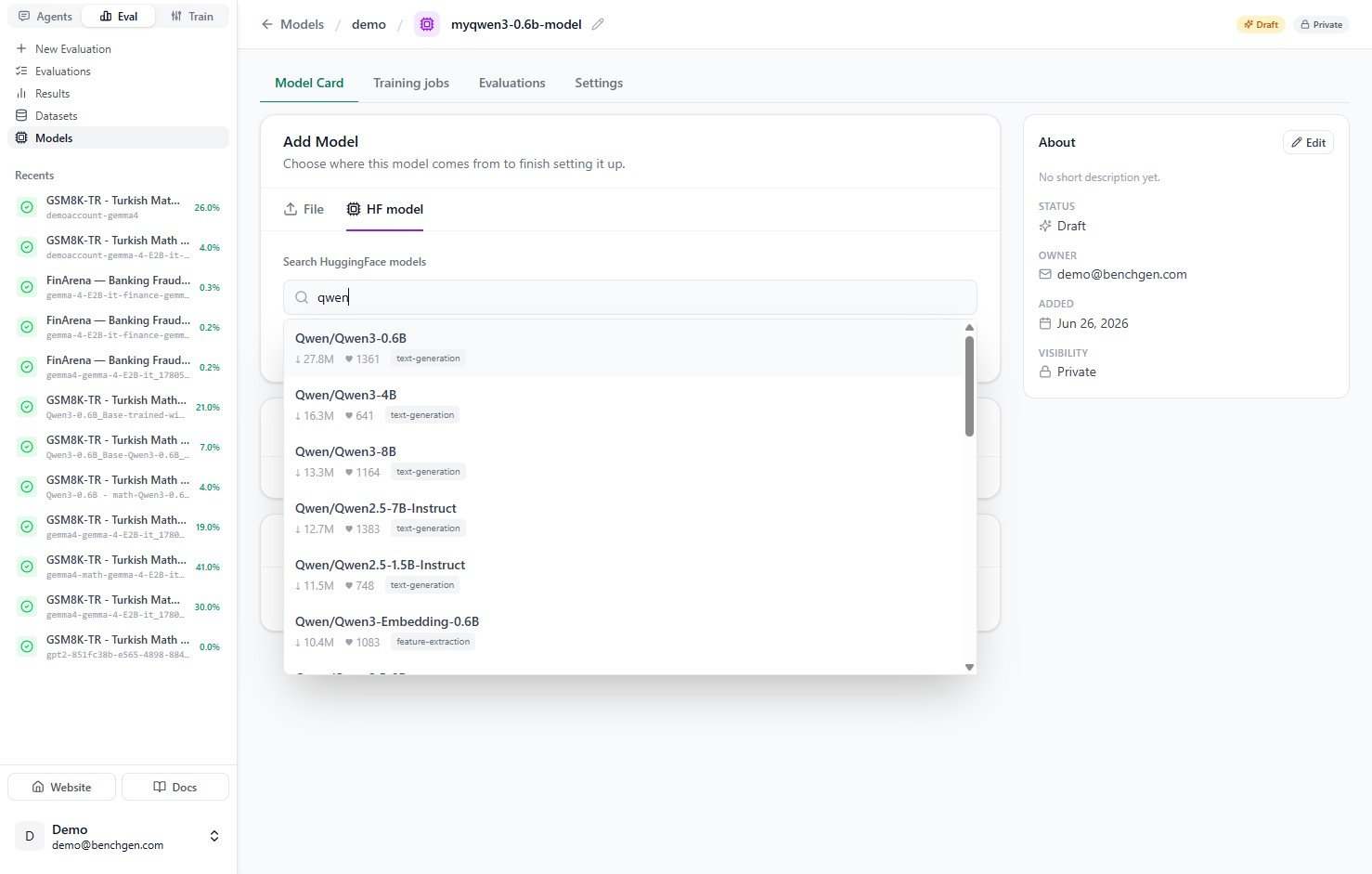
On the **HF model** tab, type a model name into **Search HuggingFace models** (for example `llama`, `qwen`, or `mistral`).
#### Option B — Import from HuggingFace
On the **HF model** tab, type a model name into **Search HuggingFace models** (for example `llama`, `qwen`, or `mistral`).
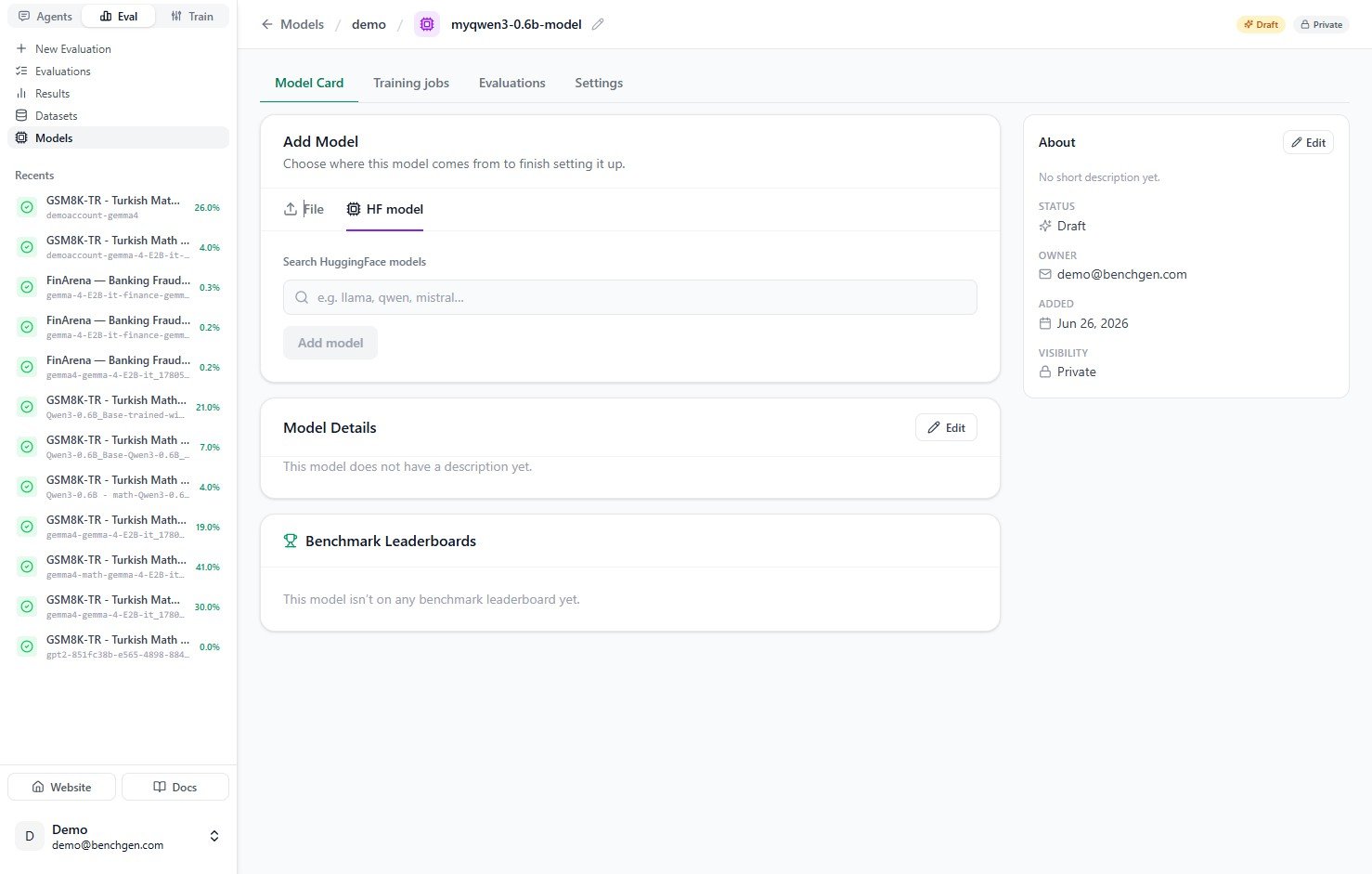 As you type, matching models appear with their download count, likes, and task tag. Click the one you want.
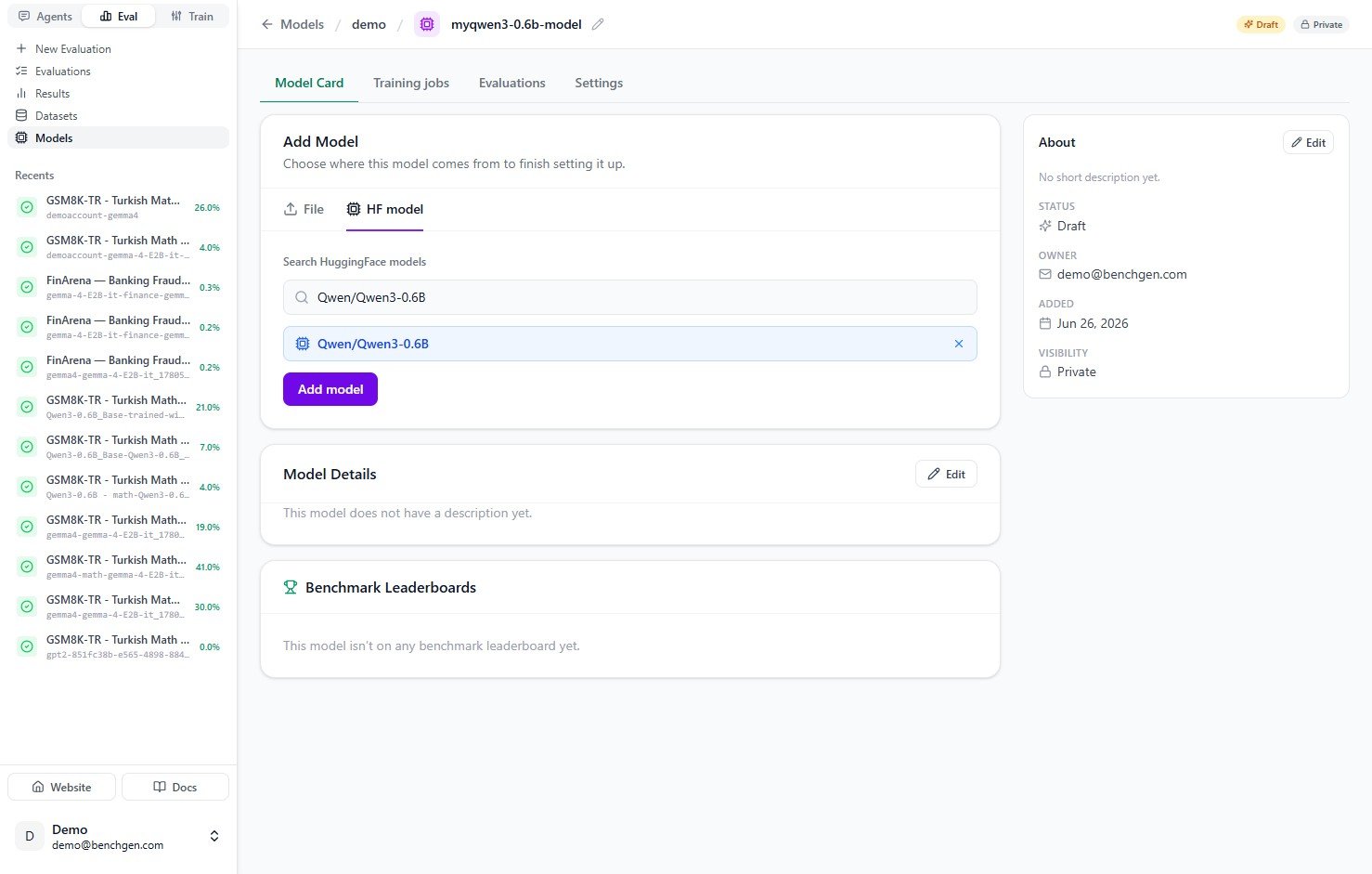
 The selected model shows as a chip, and the **Add model** button becomes active. Click **Add model** to import it.
 ### 4. Confirm the model is ready
BenchGen registers the model and provisions its endpoint. When it finishes, the status badge changes to **ready** and the model card's endpoint panel fills in with its **LiteLLM Name**, **Endpoint URL**, access **Token**, and basic information such as format and visibility.
### 4. Confirm the model is ready
BenchGen registers the model and provisions its endpoint. When it finishes, the status badge changes to **ready** and the model card's endpoint panel fills in with its **LiteLLM Name**, **Endpoint URL**, access **Token**, and basic information such as format and visibility.
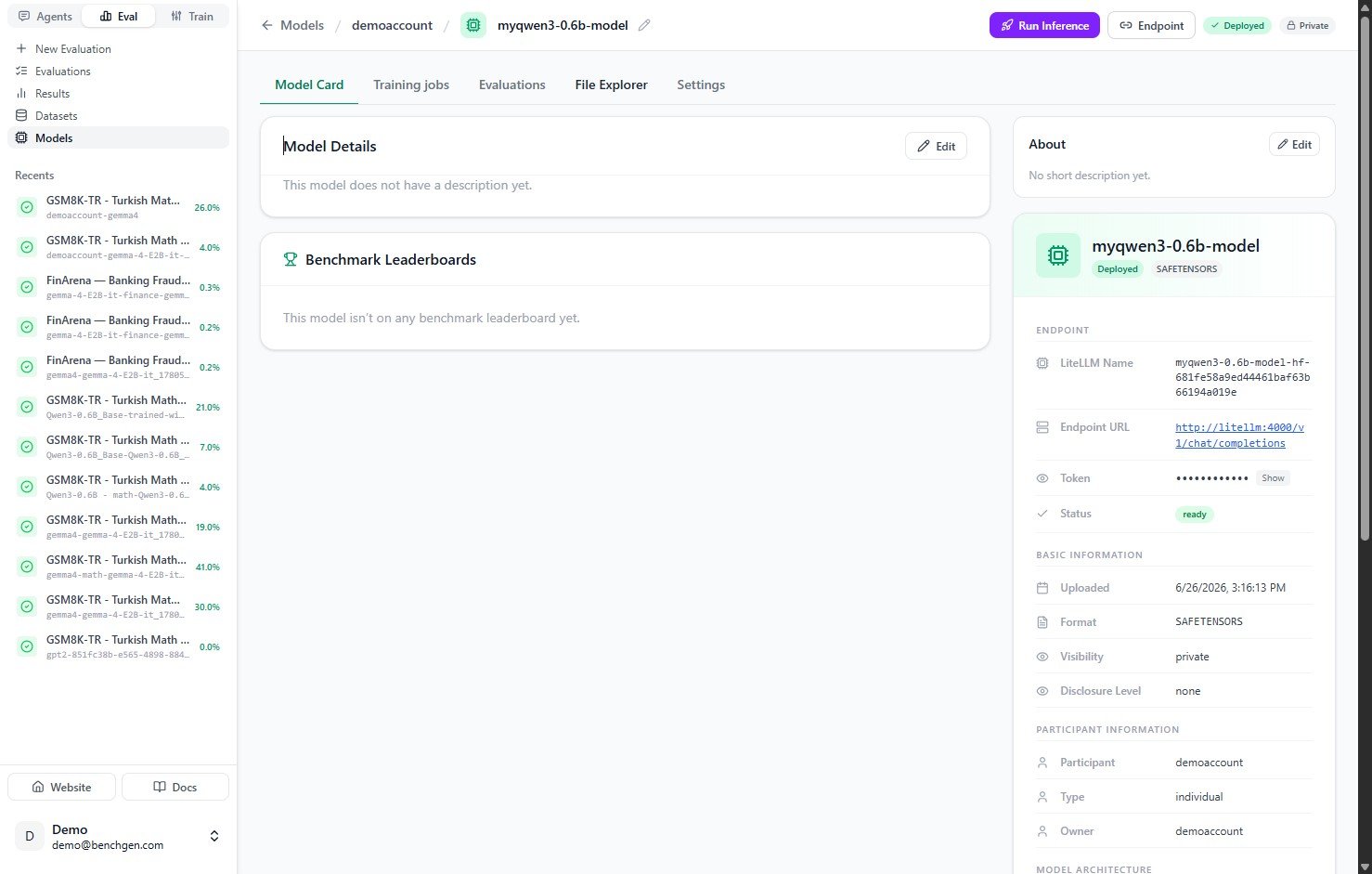 Your model now appears in the **Models** list and is available for inference and evaluation.
***
## Next Steps
* [Deploy an inference model](/eval/run-an-inference-model)
* [Evaluate an inference model](/eval/evaluate-a-running-model)
* [Run a benchmark](/eval/run-a-benchmark)
Your model now appears in the **Models** list and is available for inference and evaluation.
***
## Next Steps
* [Deploy an inference model](/eval/run-an-inference-model)
* [Evaluate an inference model](/eval/evaluate-a-running-model)
* [Run a benchmark](/eval/run-a-benchmark)