
Model Details
Kimi K3







Quick answer: Kimi K3 is Moonshot AI's most capable model — a 2.8-trillion-parameter open MoE model with native vision, a 1M-token context window, and frontier-level performance across coding, reasoning, and knowledge work. It scores 93.5% on GPQA-Diamond and 88.3% on TerminalBench 2.1, and now has 46 benchmark scores tracked on Benchgen spanning coding, reasoning, agentic, and vision tasks. API pricing is $3.00/MTok input (cache miss) and $15.00/MTok output, with cache-hit input at $0.30/MTok.
At a Glance
Where Kimi K3 leads
- World's first open 3T-class model — 2.8T parameters, largest open model available.
- 93.5% GPQA-Diamond — competitive with frontier closed models.
- 88.3% TerminalBench 2.1 — top-tier performance among all evaluated models.
- Native multimodal architecture: text and vision within the same model.
- 1M-token context with automatic, free prefix caching.
Where it lags
- Overall performance still trails the most powerful proprietary models (Claude Fable 5, GPT-5.6 Sol).
- Sensitivity to thinking history: must be used with a harness that passes full historical thinking content.
- Weights not yet released (expected July 27, 2026); currently API-only.
- Web search tool not recommended for production use at launch.
Best for: Long-horizon software engineering, kernel optimization, agentic research workflows, and multimodal knowledge work requiring massive context.
What Kimi K3 Is
Kimi K3 is Moonshot AI's flagship model and the world's first open model to reach the 3-trillion-parameter class. Released on July 16, 2026, it is a sparse Mixture-of-Experts (MoE) model with 2.8 trillion total parameters, activating 16 out of 896 experts per forward pass through the Stable LatentMoE framework. Two core architectural innovations distinguish it from its predecessor Kimi K2: Kimi Delta Attention (KDA), a hybrid linear attention mechanism that scales attention efficiently across long sequences, and Attention Residuals (AttnRes), which selectively retrieves representations across depth to improve information flow. Together these yield approximately 2.5× better scaling efficiency compared to K2.
Kimi K3 is designed for frontier intelligence across long-horizon coding, knowledge work, and reasoning. In benchmark evaluations it performed competitively with top proprietary models on most tasks, while falling short on a few: it demonstrated near-parity with Claude Fable 5 and GPT-5.6 Sol on kernel optimization and autonomously built MiniTriton, a complete Triton-like GPU compiler with its own IR, optimization passes, and PTX codegen. Native multimodal support — text and vision within one model — enables it to iterate between code and live screenshots for game development, CAD, and frontend tasks.
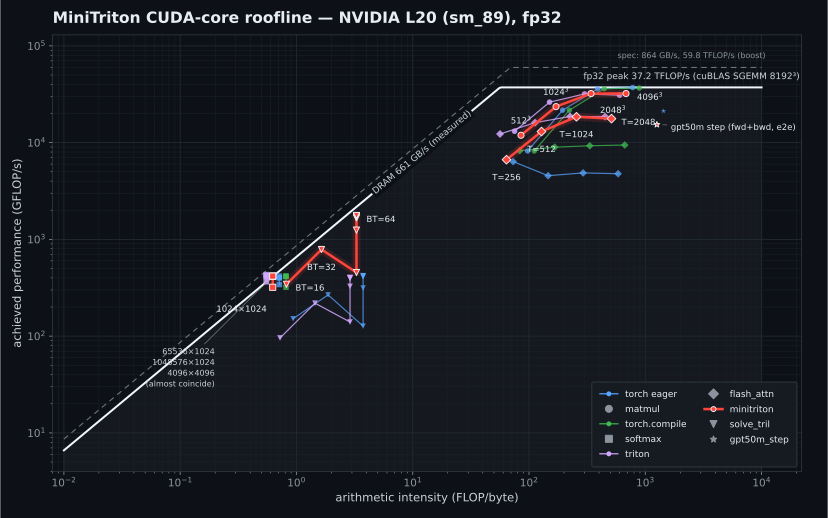
MiniTriton CUDA-core roofline benchmark on NVIDIA L20, from Kimi K3's autonomously-built GPU compiler.
Kimi K3 applies quantization-aware training from the SFT stage onward using MXFP4 weights with MXFP8 activations for broad hardware compatibility. The Kimi API achieves above 90% cache-hit rates in coding workloads, making the effective input cost substantially lower than the cache-miss list price. Deployment on supernode configurations with 64 or more accelerators is recommended for optimal throughput.
Kimi K3 vs. GLM-5.2, Claude Opus 4.8, Claude Fable 5, GPT-5.5, and GPT-5.6 Sol across the full evaluation suite.
Specifications
| Field | Value |
|---|---|
| Total parameters | 2.8 trillion |
| Active parameters | ~16/896 experts per forward pass |
| Architecture | Stable LatentMoE + Kimi Delta Attention (KDA) + Attention Residuals (AttnRes) |
| Context window | 1,000,000 tokens |
| Max output tokens | 131,072 (default); up to 1,048,576 |
| Modalities | Text + Vision (native multimodal) |
| Thinking | Always enabled; reasoning_effort=max (only level at launch) |
| Quantization | MXFP4 weights / MXFP8 activations |
| Family | Kimi K3 |
| License | Open (Apache 2.0; weights releasing July 27, 2026) |
| API model name | kimi-k3 |
| Pricing — cache-hit input | $0.30 / MTok |
| Pricing — cache-miss input | $3.00 / MTok |
| Pricing — output | $15.00 / MTok |
| Created by | Moonshot AI (Beijing, China) |
Pricing
| Input (per 1M tokens) | Cache-hit | Output (per 1M tokens) | |
|---|---|---|---|
| Moonshot API | $3.00 | $0.30 | $15.00 |
Frequently Asked Questions
What is Kimi K3?
Moonshot AI's July 2026 frontier model scoring 93.5% GPQA-Diamond, 91.2% BrowseComp, 88.3% TerminalBench. Apache 2.0 (weights Jul 27) — 46 benchmark scores.Scores from Moonshot AI evaluations. Last updated 2026-07-28.
Related Benchmarks
- GPQA-Diamond — 93.5% accuracy
- TerminalBench 2.1 — 88.3% success rate
- BrowseComp — 91.2%, top agentic search score in the eval suite
- CharXiv Reasoning — 91.3% with Python tools (84.8% without)
Kimi K3's full benchmark record — 46 scores across coding, reasoning, agentic, and vision tasks — is tracked on its Benchgen leaderboard entries.
Related Models
- Kimi K3 family: Kimi K3
- Previous generation: Kimi K2.7 Code · Kimi K2.6 · Kimi K2.5 · Kimi K2 Instruct
Last updated 2026-07-28.