
Model Details
Solar Pro 4

-555)


Quick answer: Solar Pro 4 is Upstage's agentic flagship model, released August 6, 2026, built to carry multi-step work — document review, terminal tasks, multi-turn tool use — through to a finished deliverable rather than a single answer. It supports a 512K-token context window with up to 128K output tokens, and reports 57.0 on Terminal-Bench v2.1, 89.0% on GPQA Diamond, and 70.6% on SWE-bench Verified (OpenHands). It's API-only, priced at $0.30 per 1M input tokens and $1.20 per 1M output tokens.
.png)
At a Glance
Where Solar Pro 4 leads
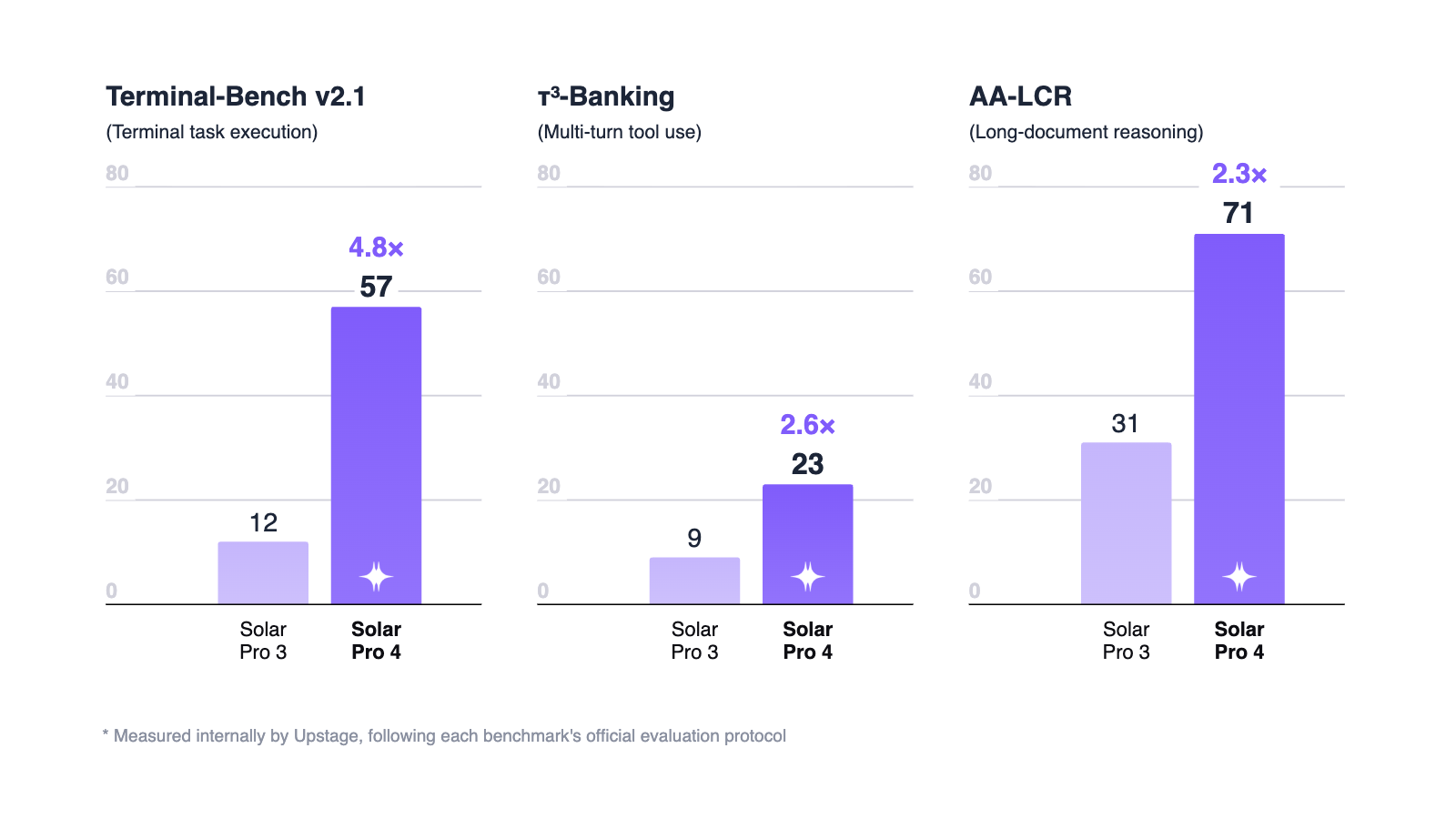
- 57.0 on Terminal-Bench v2.1 — a 4.8× jump over Solar Pro 3's 12, Upstage's largest single-benchmark gain
- 512K context window with up to 128K output tokens — enough to load several contracts, reports, and data files into one session
- Built-in evidence discipline: explicitly designed to answer "not verifiable" rather than fabricate when a document doesn't support a claim
- English, Korean, and Japanese input/output support with an OpenAI-compatible API
Where it lags
- Proprietary API-only model — no open weights, no self-hosting except via Upstage's dedicated/on-premises contract option
- Undisclosed parameter count — no architecture transparency for independent verification
- On pure knowledge/math/coding benchmarks (MMLU-Pro, AIME 2026, LiveCodeBench) gains over Solar Pro 3 are marginal (+0.1 to +0.8) — the leap is concentrated in agentic/tool-use evaluations, not raw reasoning
Best for: Long, multi-step commercial agent workloads — contract review, multi-file data reconciliation, terminal-based coding agents, and business report/deliverable generation — where finishing the task matters more than a single high-accuracy answer.
What Solar Pro 4 Is
Solar Pro 4 is Upstage's latest flagship, positioned specifically for agentic use rather than as a general-purpose chat model. Where Solar Open 2 is a self-hosted, open-weights option for organizations that need on-premises deployment, Solar Pro 4 is API-only and targets longer, more complex commercial workloads: tasks that move across multiple documents, run commands in a live terminal, and chain tool calls over many steps.
The model's training emphasis reflects that positioning. Upstage built Solar Pro 4 on top of OfficeVerse, an internal pipeline (in use since Solar Open 2) that synthesizes office tasks from real public data across 11 industry domains and 12 task types, grading each one strictly pass/fail on the final deliverable — not partial credit for a plausible-looking intermediate step. The same effort produced Ko-GDPval, Upstage's Korean office-work benchmark.
That training focus shows up most clearly in the benchmark gains: Terminal-Bench v2.1 jumped 4.8× over Solar Pro 3 (12 → 57.0), τ³-Banking (multi-turn tool use) improved 2.6× (9 → 23.0), and AA-LCR (long-document reasoning) improved 2.3× (31 → 71.0). By contrast, static knowledge and math benchmarks like MMLU-Pro and AIME 2026 barely moved — Upstage's own framing is that Solar Pro 4 and Solar Pro 3 are "roughly level" on those, with the real gap concentrated in agentic execution.
Upstage also emphasizes a specific reliability behavior: when asked a question with no supporting evidence in a provided document, Solar Pro 4 is designed to explicitly flag the claim as unverifiable (or as a "mismatch" if two source documents disagree) rather than answer with confidence. This targets a common agent failure mode — a fabricated intermediate value silently flowing downstream into a final deliverable.
Specifications
| Field | Value |
|---|---|
| Organization | Upstage |
| Parameters | Undisclosed |
| Context window | 512K tokens input, up to 128K output tokens |
| License | Proprietary — API only (dedicated/on-premises available by contract) |
| Release date | August 6, 2026 |
| Training data cutoff | February 2026 |
| Modality | Text — English, Korean, Japanese (input and output) |
| Capabilities | Chat, reasoning (default, with visible reasoning trace), structured outputs, tool calling |
| API compatibility | OpenAI-compatible (model: "solar-pro4") |
Pricing
| Token type | Price per 1M tokens |
|---|---|
| Input | $0.30 |
| Cached input | $0.06 |
| Output | $1.20 |
Available via the Upstage Console, OpenRouter, and Hermes Agent. Upstage is offering a 90% launch discount on Console and OpenRouter through September 10, 2026.
Public Benchmark Scores
| Benchmark | Score | vs. Solar Pro 3 | Source | Date |
|---|---|---|---|---|
| Terminal-Bench 2.1 | 57.0 | 12 (+4.8×) | Upstage launch post | 2026-08 |
| GDPVal-AA v2 | ~1,276 Elo† | ~1,128 Elo† (+148) | Upstage launch post (converted, see note) | 2026-08 |
| τ³ Banking | 23.0% | 9% (+2.6×) | Upstage launch post | 2026-08 |
| AA-LCR | 71.0% | 31% (+2.3×) | Upstage launch post | 2026-08 |
| GPQA Diamond | 89.0% | 85.6% (+3.4) | Upstage launch post | 2026-08 |
| BrowseComp | 49.2% | 37.3% (+11.9) | Upstage launch post | 2026-08 |
| SWE-bench Verified | 70.6% | 69.2% (+1.4), OpenHands harness | Upstage launch post | 2026-08 |
| MCP-Atlas | 61.4% | 58.2% (+3.2) | Upstage launch post | 2026-08 |
| APEX-Agents | 18.7% | 16.6% (+2.1) | Upstage launch post | 2026-08 |
| MMLU-Pro | 86.3% | 86.2% (+0.1) | Upstage launch post | 2026-08 |
| LiveCodeBench | 87.8% | 87.0% (+0.8) | Upstage launch post | 2026-08 |
| AIME 2026 | 95.3% | 95.7% (−0.4) | Upstage launch post | 2026-08 |
Scores reported by Upstage. Terminal-Bench v2.1, τ³-Banking, AA-LCR, GPQA Diamond, and GDPVal-AA v2 were run via Artificial Analysis (artificialanalysis.ai) as of August 2026, with a public AA listing "upcoming" per Upstage. BrowseComp, SWE-bench Verified (OpenHands), MCP-Atlas, APEX-Agents, MMLU-Pro, LiveCodeBench, and AIME 2026 were evaluated in-house by Upstage under its internal evaluation environment. Not Benchgen measurements.
† Upstage reported GDPVal-AA v2 as "31.4 → 38.8," which doesn't match Benchgen's existing GDPVal-AA v2 leaderboard scale (raw Elo, anchored to a human baseline of 1,000). Per Artificial Analysis's published methodology, GDPVal-AA v2 Elo scores are normalized for Intelligence Index inclusion as clamp((Elo − 500) / 2000) — a 0–1 fraction, reported by AA as a 0–100 index-component score. Reversing that formula (Elo = index_score × 20 + 500) recovers Solar Pro 4 ≈ 1,276 Elo and Solar Pro 3 ≈ 1,128 Elo, both of which land consistently within the existing leaderboard's known range (962–1,760). These are Benchgen-derived estimates, not Upstage- or AA-disclosed raw Elo values, so they're flagged with a dagger and included in the leaderboard table with that caveat rather than presented as an official score. Upstage's Korean/Japanese-specific results (KMMLU-Pro, KBL, KorMedMCQA, Ko-GDPval, Japanese Arena-Hard v2, Japanese MMLU, Japanese IFEval) are in-house regional evaluations without independent public benchmark pages on Benchgen and remain omitted from the leaderboard table above.
How Solar Pro 4 Performs on Agent Tasks
The clearest signal in Upstage's own results is where the gains concentrate: Terminal-Bench v2.1 (+4.8×), τ³-Banking (+2.6×), and AA-LCR (+2.3×) are all agentic, multi-step evaluations — exactly the profile Upstage designed Solar Pro 4 around. That's a meaningfully different pattern than its near-flat scores on MMLU-Pro, AIME 2026, and LiveCodeBench, where Solar Pro 3 already performed well and there was less room (or need) to improve.
Upstage's launch materials also walk through an end-to-end demo: given one policy document and six market-data files, Solar Pro 4 produced an Excel workbook, a review report, and a slide deck in three prompts, with a number computed in the workbook carrying unchanged into the downstream report — the kind of cross-deliverable consistency that a benchmark score alone doesn't capture, but that matters for agent deployments where output from one step feeds directly into the next.
Solar Pro 4 vs Alternatives
| Model | Terminal-Bench 2.1 | GPQA Diamond | SWE-bench Verified | Context | Pricing (in/out per 1M) |
|---|---|---|---|---|---|
| Solar Pro 4 | 57.0 | 89.0% | 70.6% | 512K | $0.30 / $1.20 |
| Nemotron 3.5 Lightning 30B A3B | 23.5% | 75.6% | 51.6% | 1M | Open weights |
| GPT-4o | — | 53.6% | — | 128K | $2.50 / $10 |
Solar Pro 4 trades open weights for a much stronger showing on real-world agent execution benchmarks than smaller open models at a comparable active-compute budget, backed by an API-first deployment model built specifically for long-running, tool-heavy commercial workflows.
Related Models & Benchmarks
- Compare: Nemotron 3.5 Lightning 30B A3B
- Benchmarks: Terminal-Bench 2.1 · τ³ Banking · AA-LCR · GPQA Diamond · SWE-bench Verified
Frequently Asked Questions
What is Solar Pro 4?
Solar Pro 4 is Upstage's agentic flagship model, released August 6, 2026. It's built for multi-step commercial agent workloads — document review, terminal tasks, tool-calling workflows — with a 512K-token context window and API-only access priced at $0.30/$1.20 per 1M input/output tokens.What does Solar Pro 4 score on Terminal-Bench?
Upstage reports 57.0 on Terminal-Bench v2.1, a 4.8× improvement over Solar Pro 3's score of 12 — the largest single-benchmark gain in the Solar Pro 4 release, reflecting its focus on agentic, tool-using workloads.Is Solar Pro 4 open weights?
No. Solar Pro 4 is API-only and proprietary. Upstage's separate model, Solar Open 2, is the open-weights option for organizations that need to self-host or run on-premises.Specs and benchmark scores from Upstage's Solar Pro 4 launch post (August 6, 2026) and developer documentation. Last updated 2026-08-12.