
Model Details
LFM2.5-VL-3B
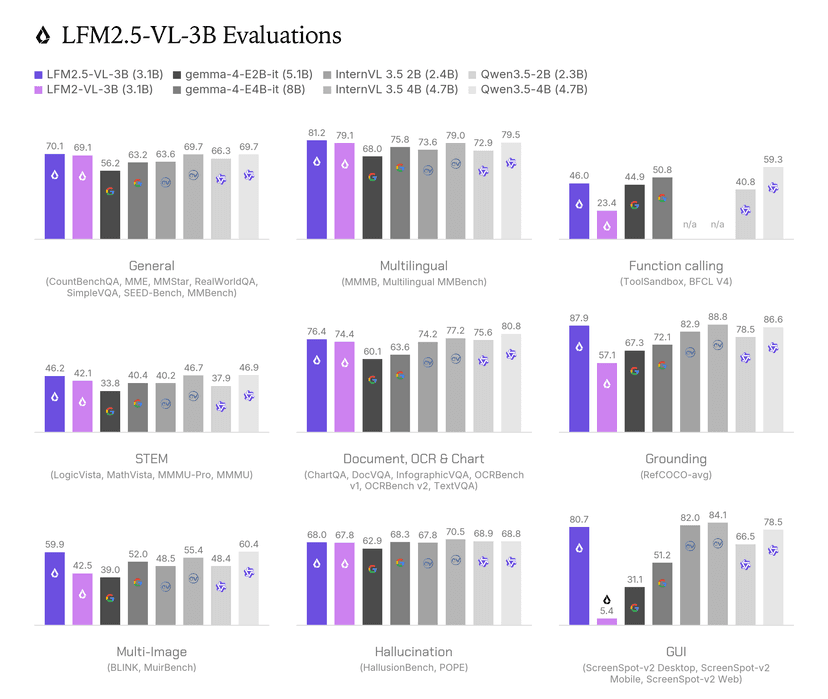
Quick answer: LFM2.5-VL-3B is Liquid AI's 3.1B-parameter on-device vision-language model, released August 12, 2026, built on the same pre-trained base as LFM2.5-2.6B with a SigLIP2 400M NaFlex vision encoder. It leads its size class on screen/UI understanding (80.7% ScreenSpot-v2), grounding (87.9% RefCOCO), and multi-image reasoning (61.5% BLINK, 58.3% MuirBench), while also posting a much stronger function-calling score than its predecessor (59.5% ToolSandbox, up from 26.4%). It decodes at 228 tokens/s on an Apple M5 Max under ~3 GB of memory. Open weights under Liquid's lfm1.0 license.
At a Glance
Where LFM2.5-VL-3B leads
- 80.7% average ScreenSpot-v2 (screen/UI grounding) — far ahead of Gemma-4-E4B-it (51.2%) and Qwen3.5-4B (78.5%), close behind the larger InternVL-3.5-4B (84.1%)
- 87.9% RefCOCO-avg grounding — a 30-point jump over its predecessor LFM2-VL-3B (57.1%)
- 59.5% ToolSandbox function calling — more than doubled from LFM2-VL-3B's 26.4%
- 228 tokens/s on Apple M5 Max, ~11K output tokens/s at high GPU concurrency on a single H100 — fastest in its comparison set
- Under ~3 GB memory footprint; runs on a phone (Galaxy S26 Ultra) at 20 tokens/s
Where it lags
- 32.5% BFCL V4 function calling — trails the larger Gemma-4-E4B-it (40.0%) and Qwen3.5-4B (53.6%)
- 48.4% MMMU (val) and 30.5% MMMU-Pro — knowledge-heavy STEM reasoning is not this model's strength relative to larger comparison models
- It's a non-reasoning model — answers directly rather than via chain-of-thought, trading some accuracy ceiling for lower latency
Best for: on-device / edge vision-language workloads — screen and UI understanding, document/OCR reading, visual grounding, and multi-image reasoning where local, private, real-time inference matters more than raw STEM knowledge.
What LFM2.5-VL-3B Is
LFM2.5-VL-3B is Liquid AI's latest vision-language model, extending its previous LFM2-VL-3B release with major improvements to screen/UI understanding, function calling, grounding, and multi-image input. It builds on the same pre-trained base as LFM2.5-2.6B (Liquid's text-only sibling model) and integrates a SigLIP2 400M NaFlex vision encoder, pre-trained on roughly 34 trillion tokens with a 4x increase in vision-pretraining tokens over its predecessor and a doubled 128K-token vocabulary to better support non-Latin scripts.
The model is a non-reasoning vision-language model — it answers directly rather than emitting a chain of thought, which keeps latency low for real-time and on-device applications such as live screen navigation or on-device document capture. Post-training combines supervised fine-tuning (including knowledge distillation from a larger teacher model and Liquid's "Antidoom" safety training) with multi-reward reinforcement learning.
On Benchgen's read, LFM2.5-VL-3B's standout results cluster around practical, agent-relevant vision tasks — reading and navigating digital screens, grounding objects in images for tool use, and reasoning across multiple images or video frames — rather than raw academic knowledge benchmarks, where larger comparison models (Gemma-4-E4B-it, Qwen3.5-4B) still hold an edge.
Specifications
| Field | Value |
|---|---|
| Organization | Liquid AI |
| Parameters | 3.1B total |
| Vision encoder | SigLIP2 400M NaFlex |
| License | LFM Open License v1.0 (lfm1.0) |
| Release date | August 12, 2026 |
| Modality | Vision + text (multimodal) |
| Vocabulary size | 128,000 |
| Training budget | ~34 trillion tokens (4x vision-pretraining tokens vs. LFM2-VL-3B) |
Liquid AI's launch blog does not separately specify the vision-language context window; the model shares its pre-trained text base with LFM2.5-2.6B, which uses a 131,072-token context window.
Pricing
Open weights, self-hostable — no per-token API pricing. Available on Hugging Face, with day-one support for llama.cpp (GGUF), MLX (Apple Silicon), vLLM, SGLang, and ONNX. Designed for zero-marginal-cost local inference: decodes at 228 tokens/s on an Apple M5 Max and 116 tokens/s on an AMD Ryzen AI Max+ 395, under ~3 GB of memory, and reaches roughly 11,000 output tokens/s at high concurrency on a single NVIDIA H100 GPU.
Public Benchmark Scores
| Benchmark | Score | Source | Date |
|---|---|---|---|
| ScreenSpot-v2 | 80.7% (avg) | LFM2.5-VL-3B launch blog | 2026-08 |
| RefCOCO | 87.9% (avg) | LFM2.5-VL-3B launch blog | 2026-08 |
| BLINK | 61.5% | LFM2.5-VL-3B launch blog | 2026-08 |
| MuirBench | 58.3% | LFM2.5-VL-3B launch blog | 2026-08 |
| MathVista (mini) | 68.5% | LFM2.5-VL-3B launch blog | 2026-08 |
| MMMU (val) | 48.4% | LFM2.5-VL-3B launch blog | 2026-08 |
| MMMU-Pro | 30.5% | LFM2.5-VL-3B launch blog | 2026-08 |
| ChartQA (test) | 81.3% | LFM2.5-VL-3B launch blog | 2026-08 |
| DocVQA (val) | 91.1% | LFM2.5-VL-3B launch blog | 2026-08 |
| RealWorldQA | 73.1% | LFM2.5-VL-3B launch blog | 2026-08 |
| HallusionBench | 47.2% | LFM2.5-VL-3B launch blog | 2026-08 |
| IFEval | 82.3% | LFM2.5-VL-3B launch blog | 2026-08 |
| IFBench | 25.8% | LFM2.5-VL-3B launch blog | 2026-08 |
| Multi-IF | 59.4% | LFM2.5-VL-3B launch blog | 2026-08 |
| ToolSandbox | 59.5% | LFM2.5-VL-3B launch blog | 2026-08 |
| BFCL V4 | 32.5% | LFM2.5-VL-3B launch blog | 2026-08 |
Scores are self-reported by Liquid AI in the official LFM2.5-VL-3B launch post, evaluated with vLLM 0.26 in non-reasoning mode using each model's recommended generation parameters.
Notable In-House / Unlisted Benchmark Results
Liquid AI's launch blog also reports scores on additional vision and multilingual benchmarks not yet tracked as standalone Benchgen leaderboard entries — mostly general-purpose academic VLM benchmarks that overlap heavily with the metrics already listed above, or whose scale couldn't be cleanly cross-verified against an existing Bengen page:
- MMStar — 63.3%
- MME — 73.1 (normalized 0–100; original scale 0–2800)
- SimpleVQA — 35.4%
- SEED-Bench (image) — 77.7%
- MMBench (dev EN v1.1) — 81.0%
- CountBenchQA — 87.3%
- MMMB (multilingual) — 83.0%
- Multilingual MMBench — 79.5%
- MM-IFEval (multimodal instruction following) — 60.6%
- LogicVista — 37.4%
- InfographicVQA (val) — 70.2%
- OCRBench v1 — 84.2 (normalized; original scale 0–1000)
- OCRBench v2 (En) — 47.5%
- TextVQA (val) — 84.3%
- POPE — 88.7 (F1 across adversarial, popular, and random subsets)
- Overall vision benchmark average (28 tasks) — 69.4%, within 0.7 points of the larger 4.7B-parameter Qwen3.5-4B (70.1%)
LFM2.5-VL-3B vs Alternatives
| Model | Params | ScreenSpot-v2 | RefCOCO | ToolSandbox | BFCL V4 |
|---|---|---|---|---|---|
| LFM2.5-VL-3B | 3.1B | 80.7% | 87.9% | 59.5% | 32.5% |
| Gemma 4 E2B (it) | 5.1B | 28.1% | 67.3% | 56.5% | 33.2% |
| Gemma 4 E4B (it) | 8B | 51.2% | 72.1% | 61.6% | 40.0% |
| Qwen3.5-4B | 4.7B | 78.5% | 86.6% | 65.0% | 53.6% |
Despite being the smallest model in the comparison, LFM2.5-VL-3B leads on screen/UI grounding and visual grounding, while the larger Qwen3.5-4B keeps a clear edge on function calling (BFCL V4). All comparison scores are as reported by Liquid AI in the same launch benchmark table; see each model's own page for scores from other sources.
FAQ
Is LFM2.5-VL-3B open source? Yes — available on Hugging Face under Liquid AI's lfm1.0 license, downloadable, fine-tunable, and deployable without restrictions.
How big is LFM2.5-VL-3B? 3.1 billion total parameters, combining an LFM2.5 text backbone with a SigLIP2 400M NaFlex vision encoder.
What is LFM2.5-VL-3B best used for? Liquid AI positions it for on-device screen/UI understanding, document and OCR reading, visual grounding, and multi-image reasoning — real-time and on-device vision-language workloads rather than knowledge-heavy STEM tasks.
How fast is LFM2.5-VL-3B? 228 tokens/s on an Apple M5 Max and 116 tokens/s on an AMD Ryzen AI Max+ 395, under ~3 GB of memory — it also runs on a phone (Galaxy S26 Ultra) at about 20 tokens/s. On GPU, it reaches roughly 11,000 output tokens/s at high concurrency on a single NVIDIA H100.
Does LFM2.5-VL-3B support reasoning/chain-of-thought? No — it's a non-reasoning model that answers directly, which keeps latency low for real-time and on-device applications.
Benchmark scores sourced from Liquid AI's official LFM2.5-VL-3B launch announcement (liquid.ai/blog, Aug 12, 2026) and the LiquidAI/LFM2.5-VL-3B model card on Hugging Face. Comparison-model scores (Gemma 4 E2B/E4B, Qwen3.5-4B) are as reported in that same table.