

Is it the model or the benchmark?
Getting this wrong is expensive either way: train against a broken answer key and you teach the model the wrong answer, rewrite a benchmark that was right and you have destroyed the measurement. So start with the benchmark, not the score.
A review of one benchmark: four findings, each with the evidence behind it
Why was this answer marked wrong?

The wrong answers of one run: the key points expected, the full answer, and the score it got
How key point scoring actually works
You need this to read the findings, and it explains most of the misses people hit. A question’s answer key is a list of points, each of which may offer alternatives separated by a pipe:- Matching is on whole words. “Intestinal” does not contain “intestine”, and “gradually” does not contain “gradual”. This is the single most common cause of a correct answer scoring zero.
- Order does not matter, and neither does the rest of the sentence. A point is found or it is not.
None of those is the model being wrong. All three are the key being narrower
than the language.
Prove the fix before applying it

Every miss explained from what the scoring saw, not from reading the answer
- Do not add a word that wrong answers also use. “Predator” appears in answers that never mention safety, so adding it to a safety key point would pass answers that deserve to fail.
- A stem is not a fix. Adding “gradu” to catch both “gradual” and “gradually” does nothing, because matching is on whole words. Add both forms, or change how the scoring matches.
What the numbers should look like
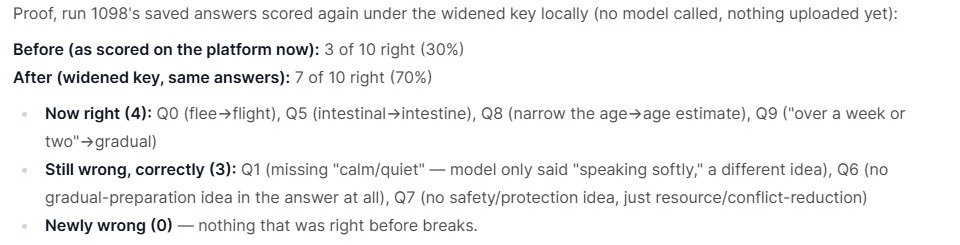
The proof, before anything was applied: 3 of 10 to 7 of 10, with none of the right answers broken
The three that stayed wrong are the healthy part. One answer said “speaking
softly” where the key asked for a calm or quiet voice; one never mentioned
gradual preparation at all. Those are genuine gaps, and a fix that had swept
them up too would have been a benchmark that no longer measures anything.
Apply it and measure for real
Runs that finished before the change keep their old scores. They are not
re-scored, because a one line change to an answer key must not quietly spend a
model run for every entry on the leaderboard. The agent lists which runs are
affected and offers to run those models again, so you can put the whole board
on one footing when you choose to.
Keep the version
A fix nobody can see afterwards is a fix nobody can review.How to ask, so you get facts back
The five messages work because of how they are phrased. The difference is not politeness, it is whether the reply can be checked.What if every answer becomes right after the fix?
What if every answer becomes right after the fix?
Treat it as a red flag rather than a success. A benchmark where everything
passes separates nothing. Either the change was too broad, or the questions
were too easy to begin with. Ask which questions still fail and why; if the
answer is none, the benchmark needs harder questions, not a looser key.
Do I have to re-run every model after a fix?
Do I have to re-run every model after a fix?
No, and nothing does it for you. Earlier runs keep their scores and are marked
as scored under previous files, so you can see which numbers are not
comparable. Re-run them when you want the leaderboard on one footing, which
matters most before you publish or share it.
One question is wrong for every model. Is that the model's fault?
One question is wrong for every model. Is that the model's fault?
Almost never. When every model misses the same question, check its answer key
first. That is the signature of a key that is wrong or too narrow, and it is
the cheapest thing to check.
When it really is the model
Not every low score is the benchmark’s fault, and the sorting happens before anything is proposed. It is likely the model when other models get the same question right, when the answer is factually wrong rather than differently worded, or when it ignored an instruction other models followed. Then the work goes to training instead: train on the questions this run missed, and measure again on the same benchmark.Related
Working with the agent
The broader guide: creating, running and training from chat.
Analyze benchmark results
What the analysis can do, and the phrases that reach it.
Edit a benchmark
Everything the agent can change, and what it will not.
Version a benchmark
Keep the history, and put an earlier version back.